A framework to manage constantly-changing states in a robust way!
This be the repo: https://github.com/pmndrs/zustand
Similar to what a state is in React, Zustand manages your states (this being “data” you want to keep track of)
The idea
You create stores and Zustand gives you a fancy syntax to update the state you stored
import { create } from 'zustand'

interface TypeStored
{
	count: number;
	int: () => void;
}

const useCountStore = create<TypeStored>((set) => ({
  count: 0,
  inc: () => set((state) => ({ count: state.count + 1 })),
}))

export default useCountStore
set is a function that does the merging state stuff for you (look below). It returns void fyi.
It will take a call-back function that takes the previous state and you return the object with the “changes” you want made.
Accessing the state
useCountStore takes in a selector function to return the value(s) of the state you want to access.
It acts as a “getter” in this scenario.
const bears = useBearStore((state) => state.bears)
return <h1>{bears} around here ...</h1>
Setting the state
const increasePopulation = useBearStore((state) => state.increasePopulation)
return <button onClick={increasePopulation}>one up</button>
Very similar, but instead of accessing the “value” from the state, we access the increasePopulation function from the state instead! Fancy stuff!
- It’s literally you getting the setter
Automagically “merging state”
Consider this example:
interface Store {
    points: number;
    increasePoints: () => void;
    setPoints: (amt: number) => void;
}

var Test: Store = {
    points: 10,
    increasePoints: () => null,
    setPoints: (num) => null,
};

var thing = {...Test, points: 0}; // This notation "opens" Test and allows you to change
// only 1 value (instead of copying all the non-changing thingys!)
console.log(thing.points); // This will now be 0; the functions do NOT change
The above demonstrates “object spread syntax” in JS. What set does in Zustand is obfuscate all that boilerplate for you
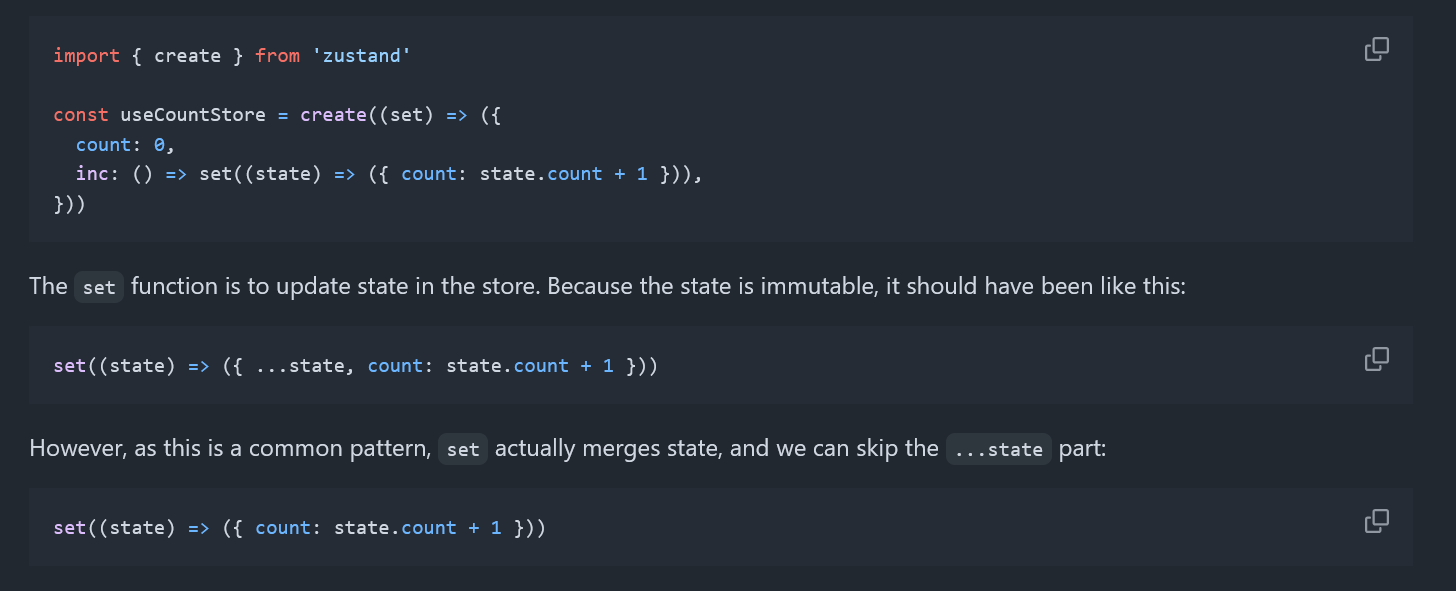
The syntax is “common” since in JS, when managing states, you should never directly mutate a state. That’s Functional Programming 101 and good programming in general
Test.points += 10; // This is evil and WILL murder your family. No doubt. ”Hooks”
Hooks are react-exclusive. Note that a store, for instance useGoalStore, when called like useGoalStore(a => a.goals) is calling a react hook.
To not call it as a hook, you simply do useGoalStore.getStore().etc.etc instead!
This is used for when your state is outside of react code.
TS Guide
Refer to https://github.com/pmndrs/zustand/blob/main/docs/guides/typescript.md