On x86-64
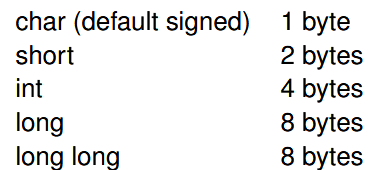 Consider the above, and there there are signed and unsigned versions of them.
- Signed = no negative. Adds 1 more bit (i.e 2x more numbers)
charis a number type! (by default it is signed)
size_t
%zu is to print vars ofsize_t which is technically different from any other number.
sizeof() returns results in bytes (not bits)
Integer literal notation
sizeof('c') == sizeof(int) since character literals are integers.
Also sizeof(3U) == sizeof(unsigned int)
int number = 3;
int char = 'c'; // char literal
unsigned int u_int = 6U; // Int doesn't have a letter
unsigned long long ull_int = 13ULL // but longs do (L)
Places of contention:
printf("lu\n", 3)would print gibberish since3is an integer, not an unsigned long.printf("lu\n", 3UL)would print correctly since we’re passing an unsigned long