“test commands” are different from other commands
- the
[]square brackets are simply to make things look nice[is literally the command name- ] is literally an argument to the command lol
[!'('"$x"' > '"$y"')']
- This “command” is still subject to all the syntax of other shell commands
- The
(character we want to pass as an argument rather than something that means something to the shell- so
'('or alternatively\(is there for that reason - Think of
''as “not for you shell; this goes into the command’s arguments!”
- so
We be on slide 14 btw
() does grouping
Things to note:
{ grep foo file1 ; ls} > file2
- The intention is to shove the output of both commands into
file2 - HOWEVER THIS IS WRONG. It willtodo what does it do
The solution is to add a
;{ grep foo file1 ; ls ; } > file2
alternatively you can do this:
{
	grep foo file1
	ls
} > file2
Grouping with () (subshells)
() groups, but is different from {}
()creates a new shell process (so the results are NOT saved)- doing
( x=hello )will NOT create a newx - running
echo $xafter will NOT work!
( x=hello! ; echo $x ) ; echo $xtodo card this (be like, “what this return?“)
BUT $((5 + 1)) this is run in the current shell (NOT a subshell)
todo Try to rewrite this WITHOUT SEMICOLONS:
if mkdir abc ; mkdir def ; then
	echo 'success!'
else
	echo 'saddace :('
fi- Also what does
mkdir abcreturn? The exit code? #todo idek what does does? Why is there two args!?
seq 5 -1 1 starts at 5, increases by -1, goes to 1
Wildcards / Patterns (to match filenames)
slide 31/56
the * represents “any part of” a filename.
- for each path, we check, does it have
*.pyin it? If so, we select it.
? matches one character
- if we have
fooandgoo, then?oowould match both of them - So would
?o?or even???
Exit codes thingys
- The exit code comes from the last executed command
getopts
- GETS OPERATIONS
getopts a-thingy variable-name
Each time you run it, it progresses to the next flag. Only when the exit code is 1 do we know we’ve gone through all our options
- I think it stops when it doesn’t see an argument within the
a-thingy? idek lol
Also note something like sh toyscript -n -- -v implies -- and -v are arguments not options, but -n is still an option
If you add an option thata-thingy doesn’t have, it will be like illegal option -k
OPTIND is your operation index. In the table it starts at 2 because when we go to the next row we know ‘okay, we’re looking at the second argument!’
- Really, it starts at
1but at the end of the firstgetoptscall, if the exit code is not 0, it should be increased to2 - If you want to go thru the while loop again, all you have to do is set
OPTIND=1Also just so you knowORTARGandOPTINDare global variables
Functions (what the flip)
sh toyscript -n -M -etc -etc

myfunction () {
	while getopts pq myflag ; do
		...
	done

	echo "$1"
	return # This exits out of a function. alternatively you can specify a value
}- Two things:
- Since
toyscriptrunsgetoptsit will chance theOPTINDbut never “reset it” so we would need to do that manually otherwise that while loop will NOT run!
- Since
Here Document
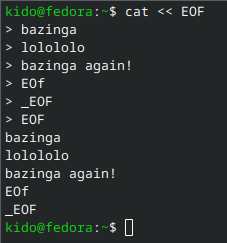
To store multi-line hard-coded text into stdin
EOFor_EOF_or whatever works. Nothing special about these terms; the shell will understand what you’re doing.- If you start with
EOF, your here document must also end withEOF