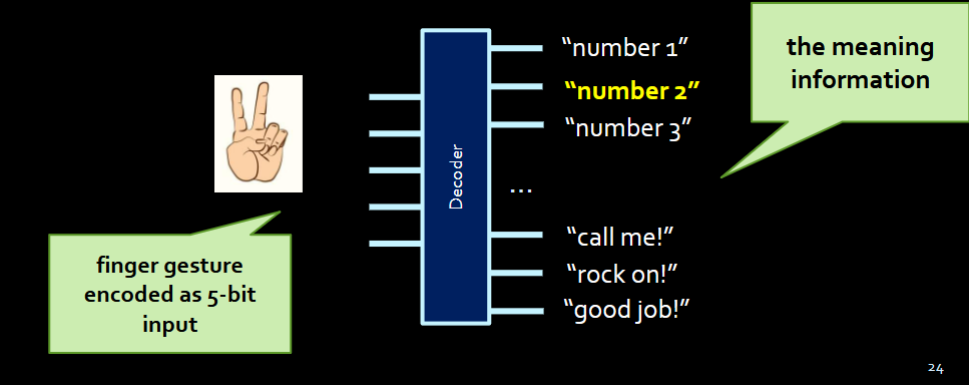
Takes a bunch of inputs of “one language” and outputs a bunch of other outputs in “another language”
- In a sense, the first lab we did was a decoder
You can have ANY # of inputs and outputs
- 5 inputs and 13 outputs is totally valid.
One-hot decoder
A common type of decoder!
- Maps binary numbers to one particular output and zero’s the rest out
- This means if there is inputs (think ) then there are outputs
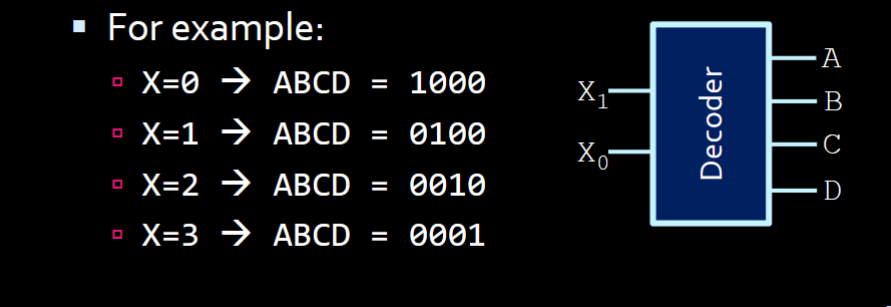
- Technically this makes this “injective” lol (not surjective because the output’s domain is far larger than the input)
7-segment decoder
- Turns binary number into instructions to display number on a seven-segment display
- To represent 0 to 9, you would need 4 bit inputs (overshooting to get 16 total input options; 8 is too less)
- The “input” would be the number you want to display; the decoder would output the correct segments to display that number
Some devices (like the segments in a 7-segment display) are “active-low” meaning they need LOW / 0 input to be on / light up.
- It’s like… inverted idk why
- Unlike lab 1 where the 7-segmment displays used active-high, strangely.
Design
- For the 7-seg display, we only need 10 of the 16 possible inputs. If making a k-map to display numbers, what do we do about the numbers past
0110? For now, let’s label them as?- Well since those inputs will never occur (and therefore they will output “nothing”), you can choose the output to be WHATEVER YOU WANT. We don’t care! They’ll never happen. “Don’t care”