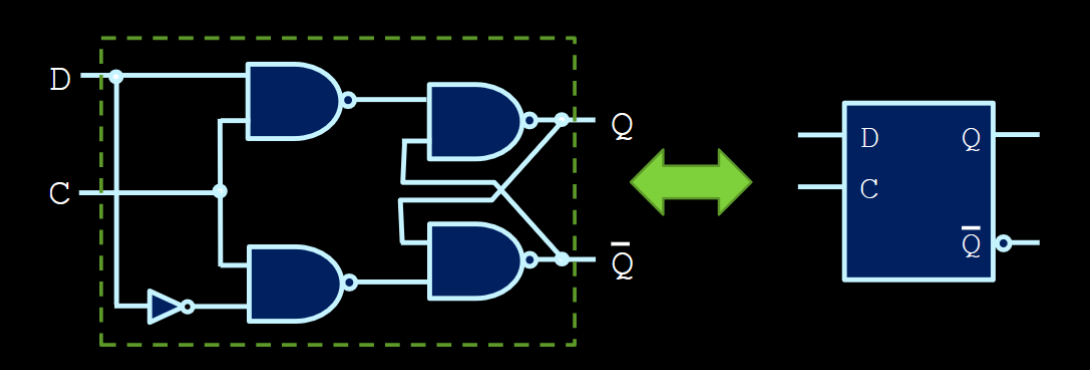
D latches are the easiest way to store a bit, and control if it can be changed or not (with C)
The design of the Clocked (Gated) SR Latch is good but those “forbidden states” really suck. Lets get rid of them!
- We force S and R to be opposites of each other (i.e. D being on means out is on; D being off means out is off)
- D = Data D latches are always clocked (otherwise why would you have all that tomfoolery going on for a straight line from Intuition Behind Storing Values)
- The clock lets you change the data once during the rising edge, and store it on the falling edge.
- And, unlike unclocked latches, we know exactly how many times the data has changed (once per clock!)
Finally, a solution to our storing issue…
 …but not for our retrieval issue
Problem: Retrieving D-latch data (and Transparency)
When the D-latch is clocked, the data Q also changes immediately depending on D. However, if Q changes immediately, and we have something like this:
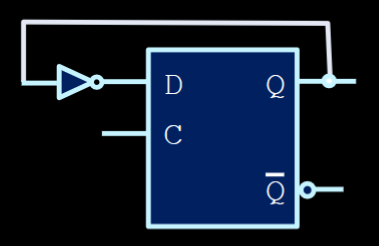 Then is set to , So Q = and Q flips. However, C is still true and therefore changes can still be made… uh oh we have unstable behaviour again :(
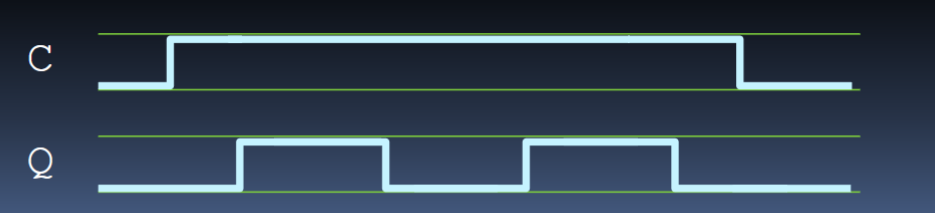
This makes the D-Latch transparent:
Any changes to its inputs are visible in the output when Clocked (C=1), like a regular wire
the output of D latches should not have a connected to its own input if the logic going from out-to-in is on the same control (clock) signal
- The path from out to in could be as simple as the inverter from above, or a proper combination circuit. Regardless, the same problem can arise
How to fix this? Flip Flops