Selects 1 output from a bunch of inputs. MUX’s These guys are everywhere.
- The “selector” S has data bits where is the number of inputs to the mux
- S selects between the different inputs you pass and “passes through” the selected.
- e.g. 7 inputs means your S would need to be data bits as that represents at most 8 numbers = 8 inputs!
- M represents the output depending on what input the chooses M to “pass through”
- The inputs themselves can have data bits (the output should have the same # of data bits too)
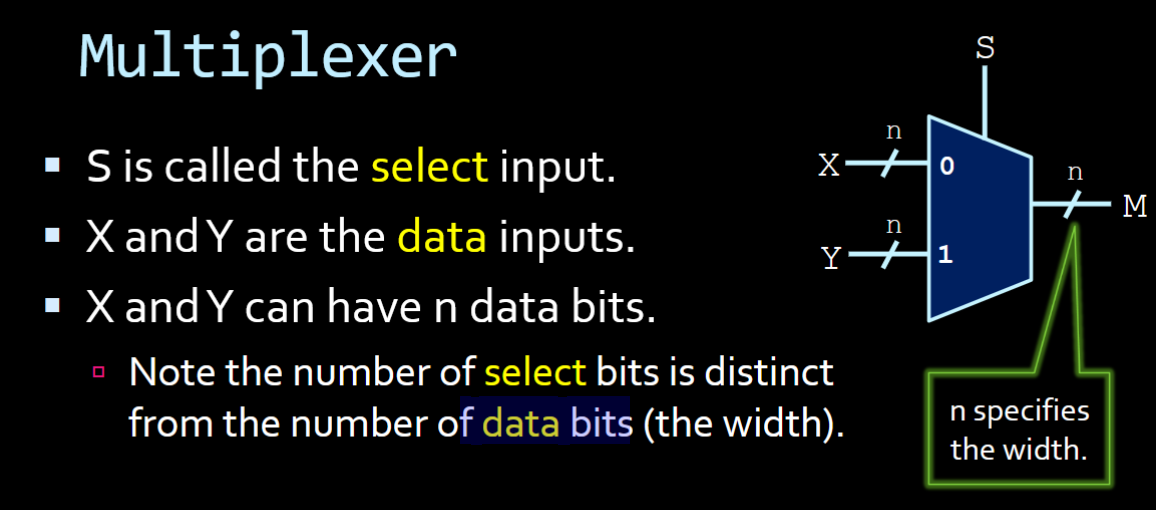
The "/" with the n above specifies how many bits the "streams" are passing. Refer to Data Bits
An 8-to-1 mux has 8 inputs, 1 output, and should have 3 select bits.
Design
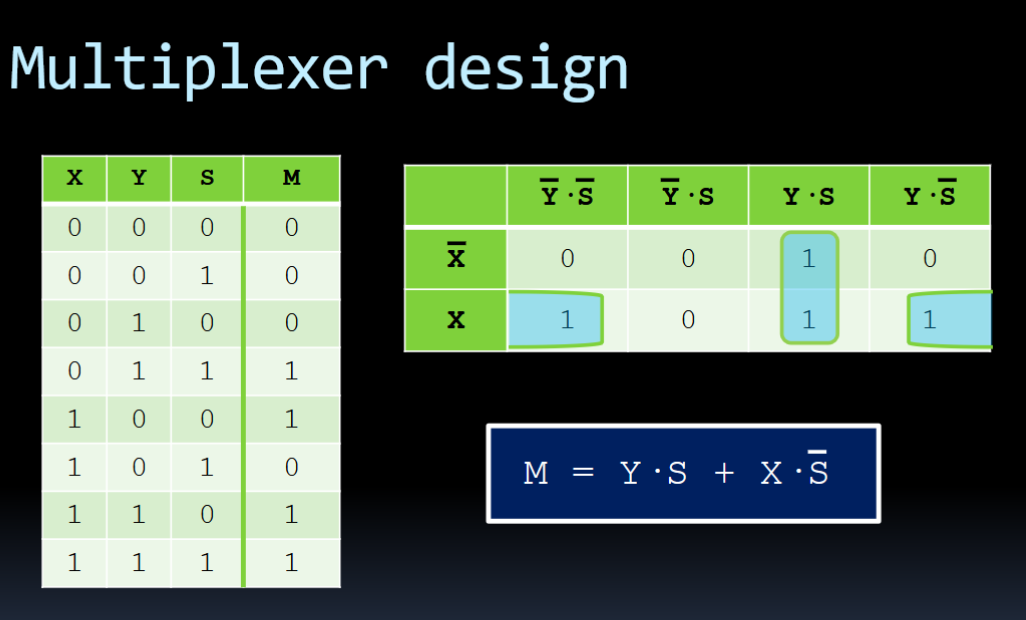
- You don’t really need a k-map since makes sense intuitively!
- If S is true, return Y. If S is false, return X. Nothing fancy here :)
- Similar thing for a 4-to-1 mux, for instance:
- For each permutation of , you would have one unique output!
Use case
- Think of TVs
- there is a mux to determine your channel.
- Think of surveillance cameras
- You can only display 1 of them at a time by selecting. Think fnaf lol