The 8 types of ASM instructions
- Arithmetic
- Logical
and,or,10101000 * 10000000=10000000. You get the idea!
- Bit shifting
sll,sra, shift less than, shift right arithmetic (multiplies by 2!)
- Data movement
mflo,mfhi, move from low, move from hi, etc.
- Branch
beq,bgtz, terrible names
- Jump
j,jr,
- Comparison
slt,sltu. Returns 0 or 1
- Memory
lw,sw
Important for me
move $t1 $t2 = add $t1 $zero $t2
li $s0 i= load immediate 32 bit number. Because otherwise you can only load 16 bit numbers with luiand oritodo
Question 2
li $t1 10
li $t2 3
sll $t3 $t2 1 # im so smart for this
add $t3 $t3 $t1
START:
blt a b ELSE
blt c b ELSE
IF:
addi b b 1
j DONE
ELSE:
subi b b 1
DONE:
li $v0 10
syscallLoops
main: # INIT
	li $t0 0
	li $t1 0
	li $t9 100 # This be the max
START: # WHILE
	beq $t0 $t9 EXIT
	addi $t1 $t1 1
UPDATE: # DO
	addi $t0 $t0 1
main:
li $t0 3 # This is X
li $t1 4 # This is Y
li $t2 0 # This is a counter
li $t3 1 # This is the result!
LOOP:
beq $t2 $t1 END # When counter = Y
mult $t3 $t0
mflo $t3
addi $t2 $t2 1
j LOOP
END:
# stuffarr: .byte 0:48
0 means each item has a value of 0; there are 48 of them
todo Slide 12 is weird
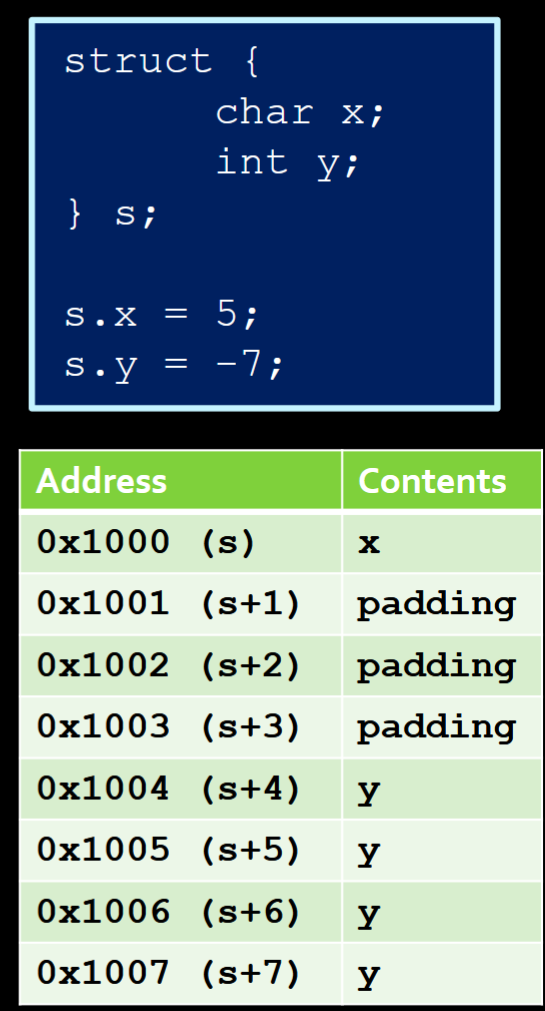
Structs must be word-aligned!
struct a {
    int a;
    char b;
};
remember that example. it’s good example! Uses padding
to add item to stack
addi $sp $sp -4 # Increase stack size
sw $t0 0($sp)
to remove item to stack
lw $t0 0($sp)
addi $sp $sp 4 # Increase stack size
Function calls:
- All args / fields go into stack in order (A, B, C)
- Then $ra goes into stack. We call with
jal - Pop ra.
- Pop C, B, A, load those n things.
- do stuff
- store returned stuff onto stack
- jump back to $ra via
jr - pop returned stuff
- donezo!
When dividing, remainder goes into the HI register whereas the quotient goes into LO