Refer to Java Compiler
Tutorials = labs
It will be known if we have a tutorial for the week or not (but it’s good to go anyway. interesting)
its all about maintainable code
sdlc
- Software Development Life Cycle (SDLC)
- Scrum
- version control
- git
team members MUST be in the same tutorial
- 5 to 6 members in total (cuz people drop the course at times!)
- Minimum is 5 is good.
the JVM is the interpreter, but it’s also compiled as when the dev writes the code, they dont run the “source code” written in any text editor; its translated to something that can be executed. the translation is done by the compiler into bytecode. it’s not machine code but similar (it’s low-level code).
- 1 line in java may become several lines of bytecode. but it’s NOT machine code as it cannot be run; it requires an interpreter (that being the JVM) on a specific device.
Java is portable as the bytecode is universal (can be run on multiple platforms!) so long as the device has the JVM (but that is platform dependent!)
graph TD

A(Create Source Code)
B[Source Code]
C[(Bytecode)]
D(Run Bytecode)
E(Result)

A-->B
B-->C
C-->D
D-->E
javac = a program we install (the compiler). This is run any command line interface (CLI). mac = terminal. windows = command prompt. etc.
javac Welcome.java compiles the java code into bytecode
- This also catches syntax errors before the code can be compiled
java = another “program” (the interpreter). Usually java and javac are installed together but they are seperate programs.
java Welcome runs the Welcome program
graph TD

A("Welcome.java (Java source-code file)")
B(Java Compiler)
C("Welcome.class (Java bytecode executable file)")
D("JVM")
E("Library Code")

A--Compiled by-->B
B--Generates-->C
C--Executed by-->D
E-->D
IDEs
- Finds syntax errors before compiling!
- Wow so nice!
Data Types
- Eight primitive types
- Byte, char, short, int long, float, double, boolean
- Anything that’s not primitive is a reference data type
todo include the table of the ranges of the data types. Could be useful!
Classes
- more than just a “CDT”
package’s let you organize classes. it’s like a folder at the end of the day.- destructors we don’t need. java uses a garbage collector that deallocates memory from objects that are not referenced anymore.
- Constructors initialize objects.
- He calls fields “fields” so that’s nice.
Object != Class. refer to Objects vs Classes
constructors without any arguments are useful when you want specific default values
in java, default values depend on the type of a field (that’s if we don’t initialize it, unlike c where it’s just garbage)
- numbers are 0
- booleans are false
- for non-primitive types, the default value is
null.- At the end of a day, a non-primitive variable/field is an address / location
- variables declared within functions are local variables and not fields.
le stac et le heap
Consider
// Point.java
package geometry;

class Point
{
	int x, y;
	public Point()
	{
		x = 0;
		y = 0;
	}
}

// main.java
package geometry;

class Main
{
	public static void main(string[] args)
	{
		Point p = new();
	}
}- When we instance an object, the class object itself lives in the heap.
- That means the fields are there too
- In the stack, the variable
pthat lives in main has a value of101301or something. this is an address to the heap!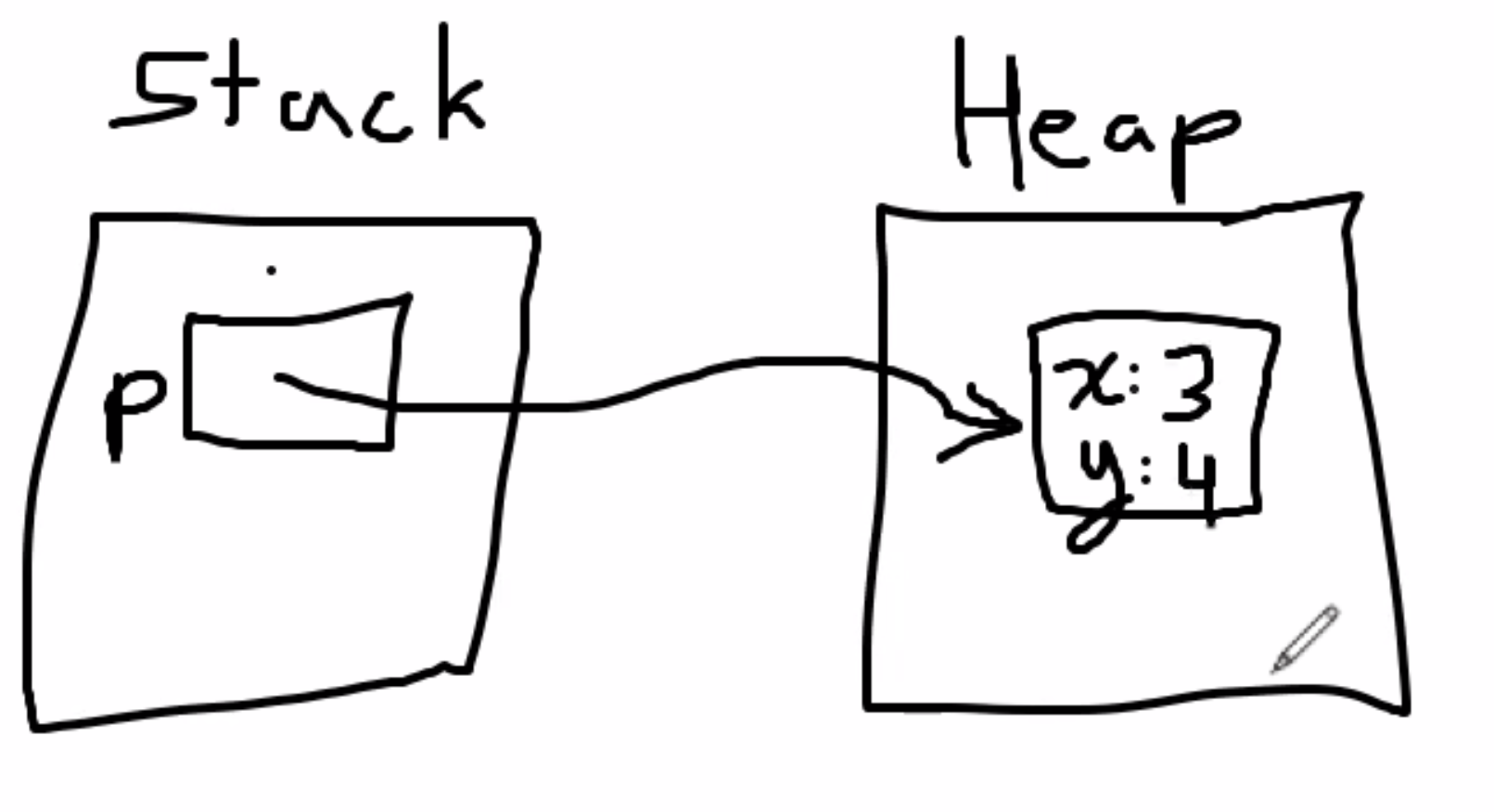
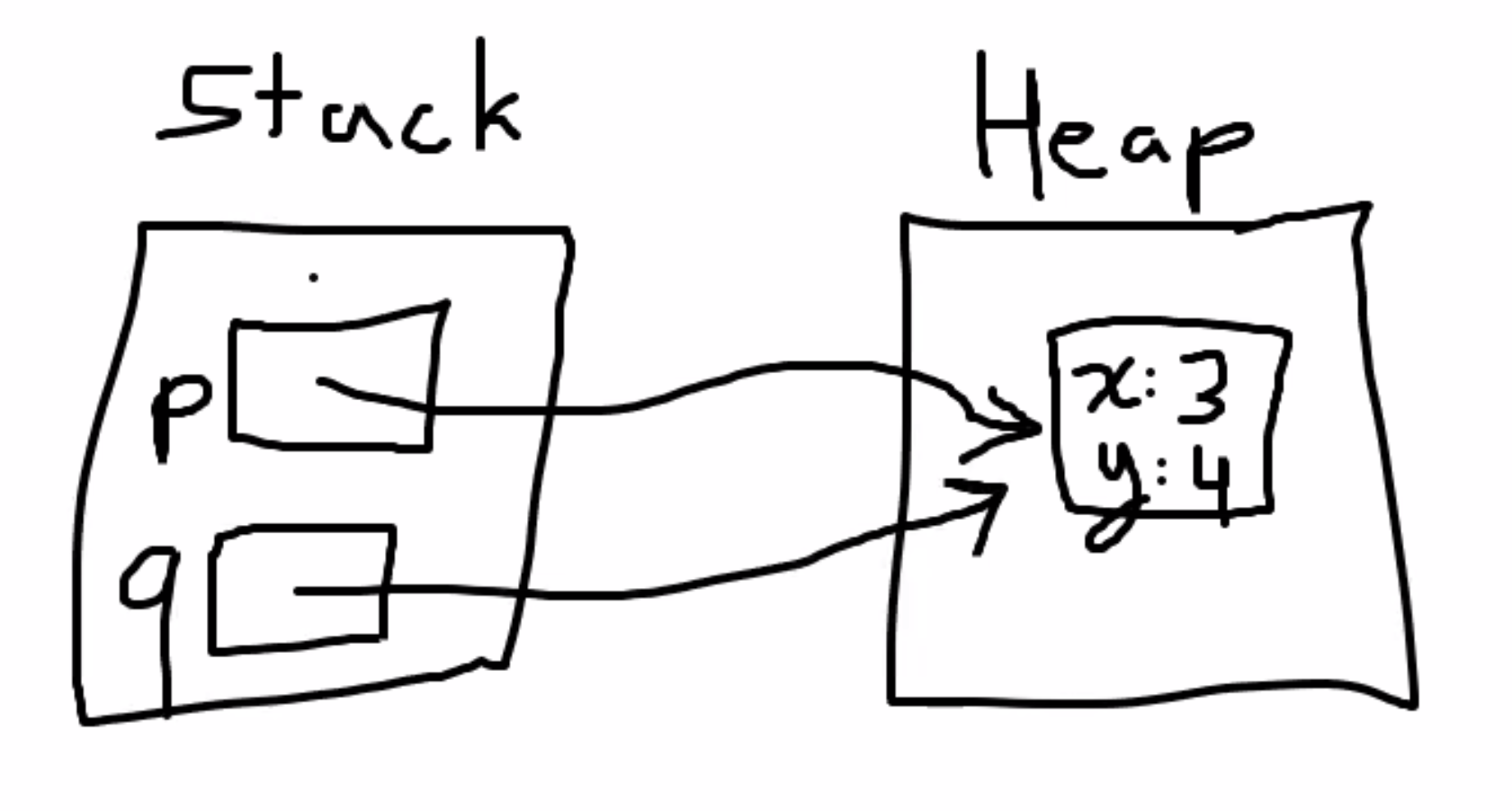
Now let’s do q = p inside of main!
public static void main(string[] args)
{
	Point p = new();
	Point q = p;
}
and lastly let’s update the field of x to 5 by doing p.x = 5 and print q.x
public static void main(string[] args)
{
	Point p = new();
	Point q = p;
	p.x = 5;
	System.out.println(q.x);
}
This would print out 5, as p and q are both pointing to the same object in the heap. Oh also in the heap the x would be swapped to 5 now yay.
todo in java, variables are by default package private so fields can be accessed in the same package like any other public variable. That is interesting!
You cannot have two constructors of the same signature (variable names are not part of the signature btw yeah that’s kinda obvious though isn’t it.)
public Point(double x)
{
	x = x; // This refers to the variable from the *argument* and NOT the field.
	this.x = x; // That is how you refer to the field!
}
this = the object instance from which we are manipulating. Rawad calls it the calling object. the above example, p or q could be that calling object.
we don’t need this iff the field / local variable is not ambiguous.
we might also use it in the following scenario:
- referencing the object, to pass into a method for example
- This will be useful later in the class buttodo i wanna know anyway.
Calling new creating an object instance on the heap
on slide 10 we talk about string literals
static = shared between all instances of the class. You can reference static members by just using the class name and the . operator.
- You can also use an instance to call static members… but that’s ewww.
public static void main(string[] args)
{
	Point p = new();
	Point q = p;

	Point.staticMethod(); // Correct!
	q.staticMethod(); // Also valid; also ew...

}