Composed of the opcode and then everything else
in MIPS the opcode is 6 bits and the “everything else” is 26 bits.
Each instruction has the info needed to decode the instruction (know which kind it is) and execute the operation (with the args given)
There are 3 types!
The opcode determines the type. If the opcode is 000000 then it is always R-Type. Otherwise you need a lookup table
Then the Instruction Register takes in the 32-bit instruction fetched from memory and splits it.
- R-Type = Register Type Instructions
- Operations on registers
- opcode is
000000 rsandrtare two source registers- We have 1 destination register
rd shamt.is shift amount and required if we’re doing a shift operationfunct.specifies addition, subtraction, etc.
- I-Type = Immediate field
- rt becomes the destination
- rs is still the first number
immediateis some constant number- If you want to, say, branch (i.e. when u have an
if-elseand you skip the if) if you want to store the next instruction to go to, you use the signed difference.- Cuz the immediate field is 16 bits but the address is 32 bits!
- Example is on slides
- Because all instructions are divisible by 4, you can ignore the first 2 zeros since they are always like that. Boom 18 bits ?todo
- The
Sign Ext.part turns the 16 bits into 32 bits
- J-type instructions
- Jump + Jump and Link
- Jump is literally “jump to an exact place in memory”. All of
addressis used to store the address (which are 32 bits) - But we can only manage to store 26 bits (2 to 27) and miss out on the highest 4 bits
- So you cannot jump to values with the last 4 bits not all 0
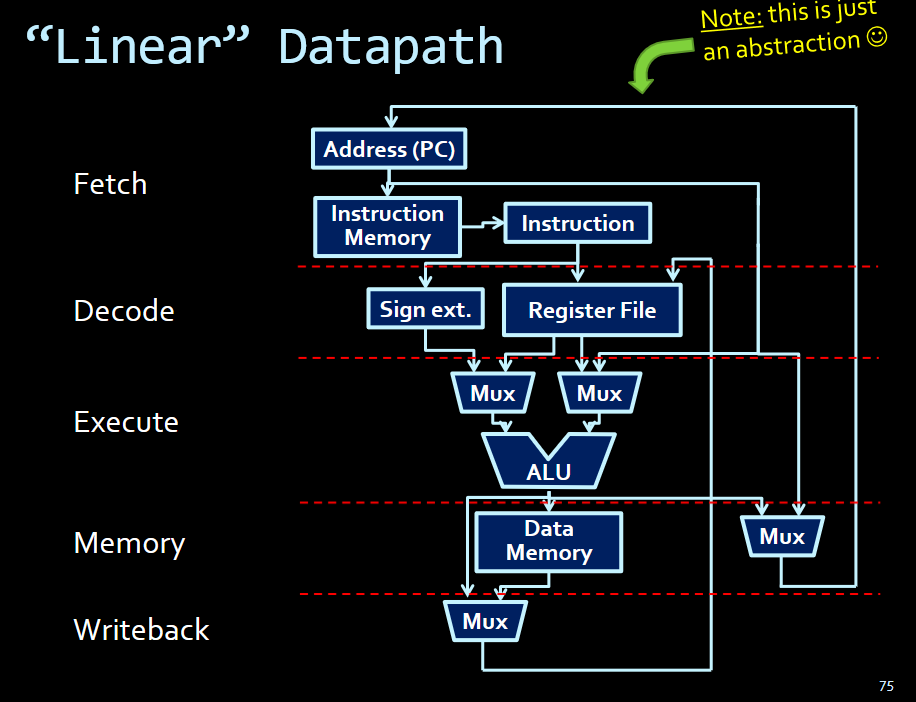
Linear Datapath abstraction & Instruction Decoding
R-Type
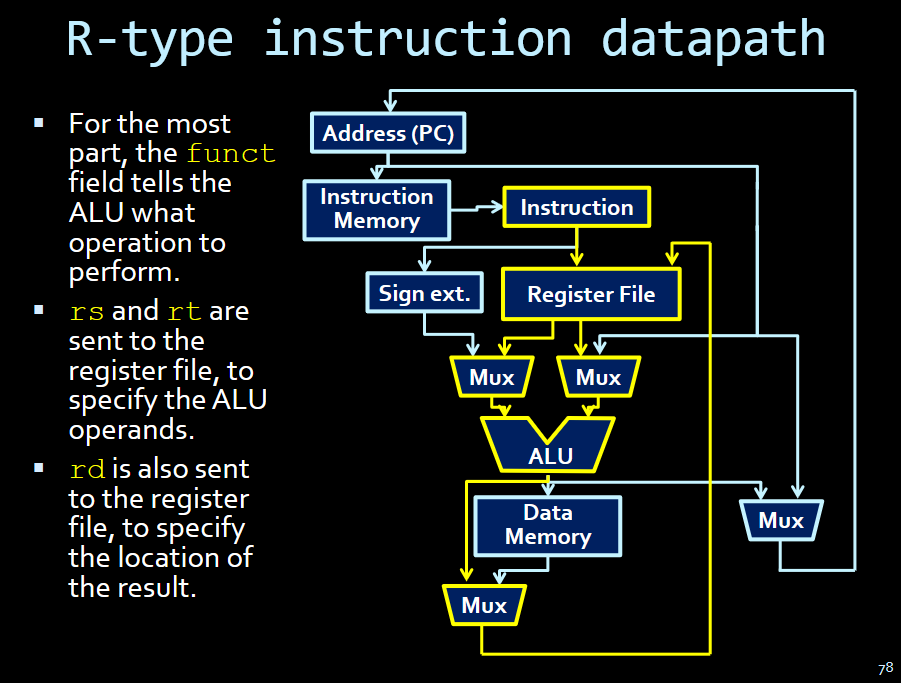
- The instruction goes into the register file (we don’t sign extend — that’s for type-I)
- That instruction decides what data to pull from register file. Then we do some MUX stuff, ALU stuff, and the output is chosen to go back into the register file to (but for writing!)
- We don’t need to use Data Memory — that’s for repeating an instruction instead of incrementing. Incrementing PC is also not included
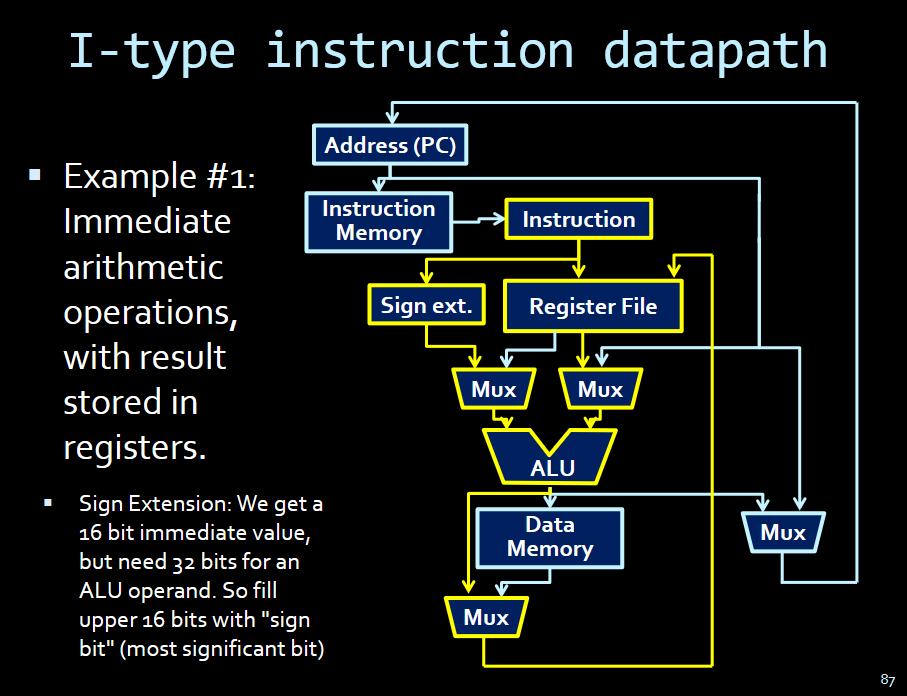
- Instruction, sign extension (for the immediate) register file, muxes, alu, mux to store result.
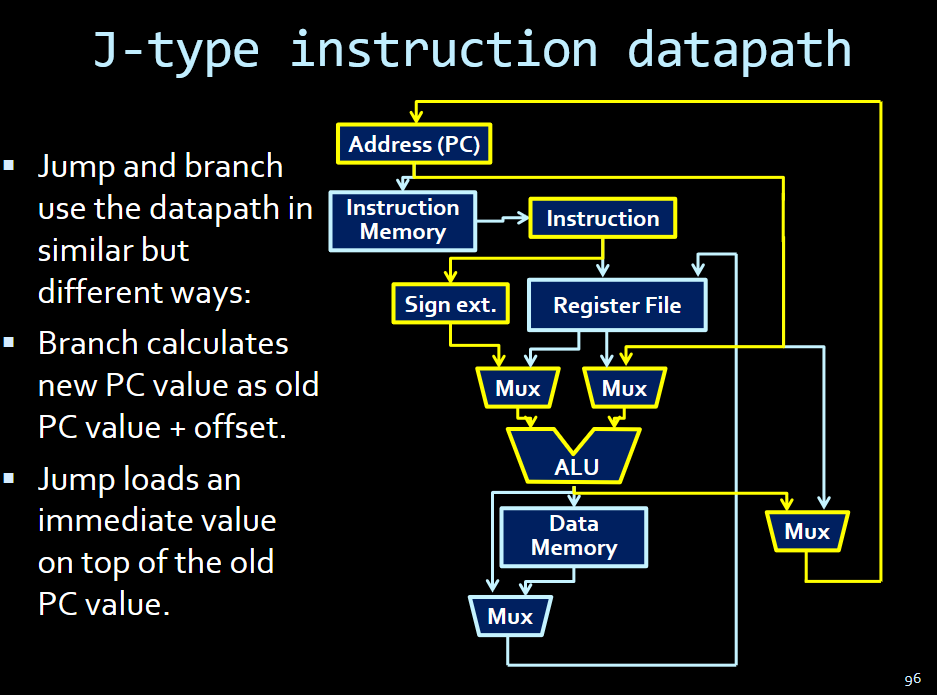
- Instruction, sign extension (add 0’s cuz the instruction is too short), both muxes (remember we gotta shift by 4 to get the OG operation!), ALU, the right mux, the PC.